

Since its inception in 2001, the ICTC’s in Mumbai have been consistently delivering quality services across its vast network. People were visiting the centers, getting counseled, tested and referred for further treatment. However, even a decade after its existence, certain problem areas were identified by MDACS.
• Lack of Visual Identification for ICTC: Even within a government hospital, a client could not identify the ICTC. The ICTC had no visual image that the user/non-user could relate to.
• The brand ICTC is almost unknown: An ICTC was an HIV testing center that was a unit of the hospital and that was the end of their (user & non-user) understanding of this service.
• Fear of Testing: There is a fear associated of being stigmatized / discriminated against if one uses the ICTC
Research Strategy
With the identified issues at hand, MDACS planned to develop a comprehensive, evidence based communication strategy to increase awareness about the HIV counseling and testing facilities available in the city; and motivate andmove appropriate population to get counseled and tested in these centers.
As a prerequisite to the strategy development, it was proposed to conduct a formative study with quantitative and qualitative research methods in order to confirm the above stated premise of the problem areas and also establish baseline indicators on the city residents’ knowledge, attitudes and practices about HIV testing and ICTC.
Research Objectives
• Gauge awareness of, attitude towards and utilization of ICTC and HIV testing
• Understand the motivators and barriers in accessing ICTC services
• Client’s perception about ICTC services
• Gain insights into the media reach and media habits of the target populations so as to ensure maximization of the reach of the resultant communication campaign
Research Questions
1. Knowledge about HIV testing & ICTC
• Sources of Information for HIV testing & ICTC
• Specific service related knowledge
• Reasons for visiting HIV testing center
2. HIV related knowledge, perceptions and practices
• Self-risk perception of HIV
• Community risk perception of HIV
• Actual HIV testing in last 6 months
• Place of HIV testing
• Reasons for getting tested for HIV
• Intent to get tested for HIV
3. Media Habits of different population groups
• Access to different forms of media
• Exposure to folk media
• Access to advertising media
Sampling – Primary Research
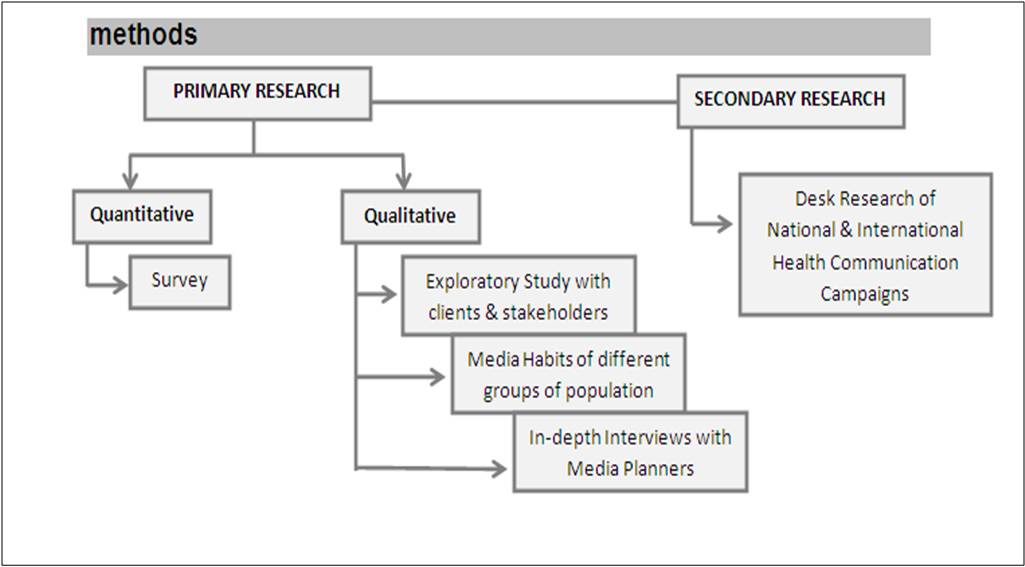
1. Quantitative Survey: A cross sectional study was conducted among 5 target population groups with a total sample size of 450 respondents.

2. Qualitative Research
a. Rapid Exploration Exercise was conducted among 58 stakeholders to gauge the awareness of, attitude towards and utilization of ICTC and to explore issues in access to these centers.Stakeholders included Users of public health services (Users and Non-Users of ICTC), Counselors and ICTC administrators from different types of ICTCs, Hospital staff and NGO staff and Potential friends of ICTC (Paanwala, Medical shop owners, Bar owners, Taxi, Rickshaw drivers etc.)
b. Media habits of different groups of population: Titled ‘A day in the life of’ this research exercise of in-depth interviews was conducted with 15 participants from 5 target groups of population, to understand their media touch points and the type and flow of ICT that reaches them on a typical day.
c. Structured in-depth interviews was conducted with 3 Communication Professionals from the Advertising Industry with an aim of understanding the most effective media channels to reach different groups of populations in the context of creating universal awareness of ICTC.
Secondary Research
A total of 23 health related communication campaigns were studied out which 14 were national campaigns while the remaining 9 were international.
Findings & implications
One of the key findings that emerged was that although there was a universal awareness of HIV testing; very few had actually heard about ICTC.
HIV testing is a mandatory health routine for pregnant women. Yet it is astounding to see that even though 84% of pregnant women had heard of HIV testing; only a miniscule 7% heard of ICTC, inferring a lack of recognition and identity of this service.

Free HIV testing is one of the key features of the ICTC as it offers a crucial service for all and removes the economical barrier for demand generation.
Universal awareness of free testing was found only among High Risk Group. Two in three respondents from bridge and pregnant population were aware of the free testing element. Only 59% of non-slum based general population feel that HIV testing is voluntary.

Low self-risk perception of HIV was observed across respondents.
Although most respondents feel that they have low/no chance of contracting HIV; nearly 1 in 5 (19%) non-slum based general population reported being at moderate risk of contracting the infection.

When asked if they could go and get tested for HIV in a nearest testing facility majority of respondents across all target groups said that they agreed/strongly agreed with this statement.
Almost half of slum and non-slum based general population felt that they could go to the nearest testing facility and get tested for HIV, highlighting the intent to adopt this behavior.

When respondents were asked they would be able to take the right decisions for future actions if they get tested, most agreed/strongly agreed with this statement implying that people are aware of the benefit of getting tested for HIV.

Respondents were asked about their community’s approval for getting tested for HIV. They were asked to estimate how much percentage of their community would approve of them getting tested.
Although high support for testing was observed from HRG community, 1 in 3 respondents from the remaining groups felt that less than 25% of their community members would approve of them getting tested for HIV. These figures highlight the low extent of social/community acceptance attached to the behavior of testing which further blocks the person from getting tested.

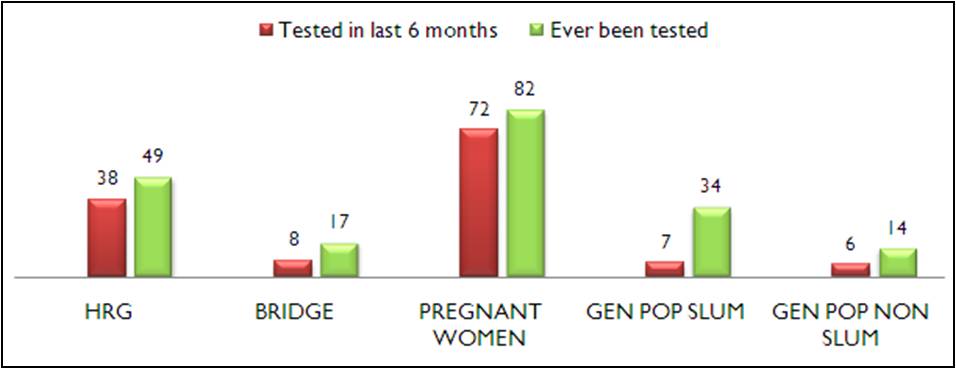
Respondents were asked if they had tested for HIV (ever tested/tested in last 6 months preceding the survey). High testing figures were observed among respondents from High risk group and pregnant women.
The lowest proportion of respondents who had ever been tested for HIV was from bridge and non-slum based general population. Testing behavior needs to be encouraged especially among risk groups.
Majority of respondents from all groups except non-slum based general population got tested in a government facility.
Even though ICTC and government testing facility are the same, respondents were still confused about the co-existence of the two. This is evident in the divided responses between ICTC and government hospital.
Respondents have gone to the government hospital to get tested for HIV but are not aware that this facility is called the ICTC.

Respondents were asked about their intent to get tested for HIV in the next 6 months, on which almost 40% of HRG responded affirmatively.
Low intent to testing was observed among bridge, pregnant and non-slum based general population. However almost 1 in 3 respondents from slum based general population showed intent to get tested for HIV in the next 6 months.

Respondents who showed intent to get tested in the next 6 months were further asked about where they would get their HIV test done. Majority said that they would go to a government facility.
• 79% of HRG will go to ICTC
• 82% of Bridge population will go to Government hospital
• 77% of pregnant women will go to Government hospital
• 55% of Slum based general population will go to Government hospital
• 100% of Non-Slum based general population will go to Private lab
Except for HRG, respondents who want to go to the government facility are not aware that it is called the ICTC.
Top 2 reasons why people from the community might not get tested for HIV

Clearly more than 50% of the low risk groups feel that people from their community may not get tested because of the fear of being stigmatized.
Media Access & Exposure
• Access and exposure to television was high across all groups.
• In the case of newspapers however, low risk groups (pregnant and general population) had higher exposure.
• Majority of slum-based general population (35%) and bridge population (20%) confirmed to have watched ‘Nukad Naatak’ (street plays).
Top forms of advertising media that respondents’ came across while travelling

Proportion of respondents that came across print media on HIV testing

Qualitative Findings Revealed:
NONE OF THE USERS of ICTC except one from the HRG group knew what ICTC was and did not know the testing centre by the name of ICTC. It was known by the OPD no. For instance in one of the Hospital examined it was called ‘OPD no. ‘401’.
Clients would refer to the ICTC in the dispensary, by the name of the dispensary (‘XXX Dawakhaana’)
All USERS knew that HIV testing was free but did not know that they can walk in without doctor’s prescription. Awareness about ‘Voluntary testing’ is essential.
NONE OF THE NON-USERS around ICTC (even those sitting in the same hall or the next OPD very close to ICTC) knew about ICTC or where the HIV test is done.
There were no clear prominent signages highlighting the facility. Long form of ICTC was written in English or Marathi- but this did not make sense to the users& non-users.
OUT OF 14 STAFF of the hospitals (including nurses, attendants, security guards) only 2 had heard the name ICTC. Most did not know the full form.
They all knew about HIV testing and refer to the ICTC by the OPD No.They also guide clients by using the OPD No.
People do not know about the services- though the current ad says how one can get HIV and importance of testing, they don’t say that every BMC hospital next to your house offers free HIV testing - That line is missing from the communication.
Poster and map at the gate (all entrances) is required for easier access and Map with clear indication for direction. Also center/brand name should be in Marathi or Hindi. For referred patients who are illiterate so particular colour for identifying the OPD will help.


